Module

Production

Manufacturing module (BOMs, orders, costing, shop floor)

The whole manufacturing loop: versioned bills of materials, shop orders, routings and work centers, work in progress, stage costing and a shop-floor terminal for operators. The plan respects work-center capacity and shows what exactly blocks output — material, tooling or people; when dates slip it recomputes itself instead of reporting after the fact. A wholesaler with no production does not need it: switch it off and the data stays; switch it back on tomorrow, or for a separate legal entity.

Business outcome
Manufacturing module (BOMs, orders, costing, shop floor)
Digital employee
Queues orders so work centers do not idle
Human control
Proposes the plan; the foreman confirms the release
Verified product route
/production/board
Manufacturing order
Planned
Bill frozenVersion and substitutions
On the floor
Operation at a work centreShift and capacity
Produced
Actual versus planVariance calculated
An empty bill will not launchMove one thing, see everything
DIGITAL EMPLOYEES · LAUNCH

Digital employees run the work — AI is not a side panel

They read the same documents as your team, prepare the next action, surface exceptions and keep the decision trail inside the process.

You set the authority. External messages, money and irreversible actions remain approval-gated until verified evidence earns a wider mode.

  1. DAY 1See the process working

    Choose an industry preset and start with realistic demo data; the team sees the target flow before migration.

  2. FIRST WEEKConnect real evidence

    Import or connect source data. Digital employees observe, draft and expose gaps while people confirm decisions.

  3. TARGET · 4 WEEKSMove the operating loop

    For a typical 50-person company, the target is four weeks. Source quality, integrations and legal requirements can change it.

Who does the work

The digital employees of this module

A module is more than screens. Digital employees work behind them: they prepare the decision and bring it to you instead of waiting for you to type everything in. Below — who exactly, what they do, and where their authority stops.

Shop-floor planner

Queues orders so work centers do not idle

  • schedules orders across work centers by capacity and dates
  • shows what blocks output: material, tooling, people
  • recomputes the plan when dates slip, not after the fact

Proposes the plan; the foreman confirms the release

WORK, NOT A FEATURE LIST

See what changes in the workflow — and where it lives in the product

Every capability below is tied to an implemented product route. A reviewed product screenshot is shown when it exists in this language; otherwise the route is explained as a transparent work loop, never as invented UI.

  1. 01

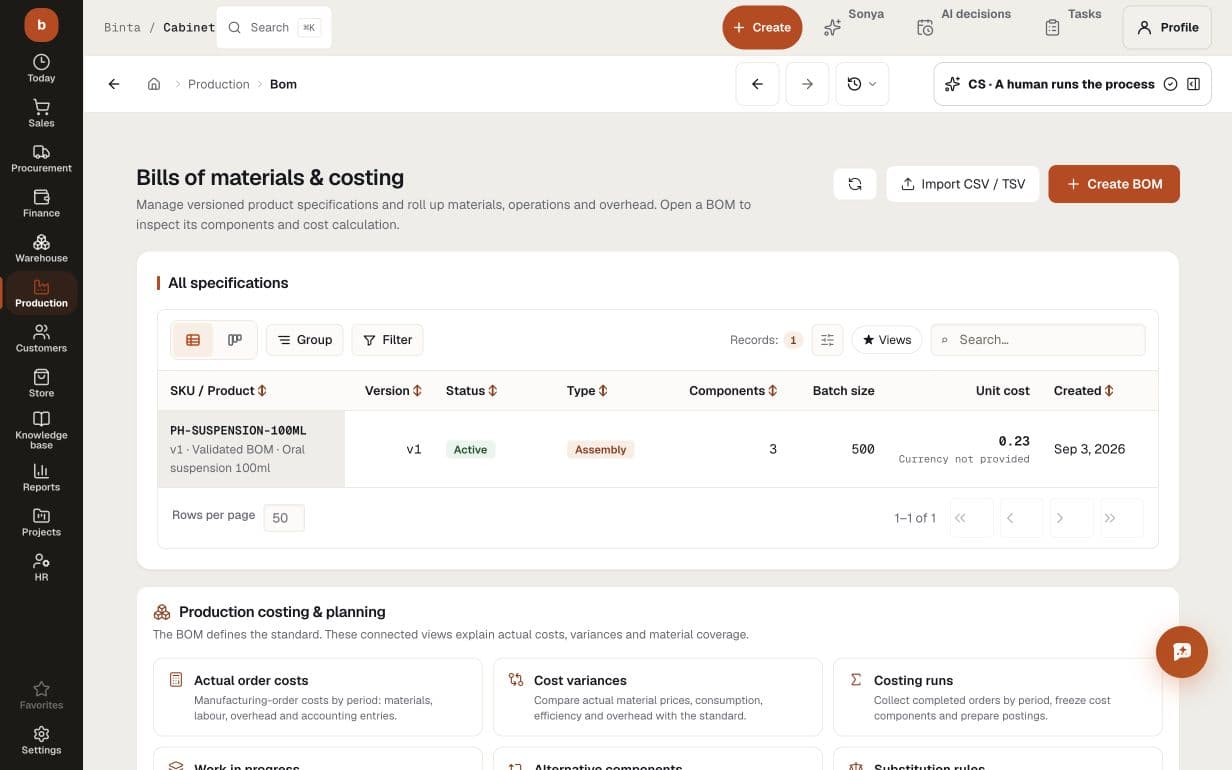
    Bills of materials with the costing inside

    BOM versions and statuses, components, batch size and unit cost — in one card, not a separate report. Ranked raw-material substitutes and substitution rules for shortages. An empty bill is refused at launch. Import from 1C and Excel included.

    PRODUCT ROUTE/production/bom
    01SignalBills of materials with the costing inside
    02Digital employee preparesschedules orders across work centers by capacity and dates
    03Human decidesProposes the plan; the foreman confirms the release
    Work map built from the implemented product route — not a stock image.
  2. 02

    Planning: demand, capacity, dates

    MRP and MPS work out what to buy and launch and when; APS spreads it across capacity and shifts. You see where the plan breaks against resources.

    PRODUCT ROUTE/production/planning/mrp
    01SignalPlanning: demand, capacity, dates
    02Digital employee preparesschedules orders across work centers by capacity and dates
    03Human decidesProposes the plan; the foreman confirms the release
    Work map built from the implemented product route — not a stock image.
  3. 03

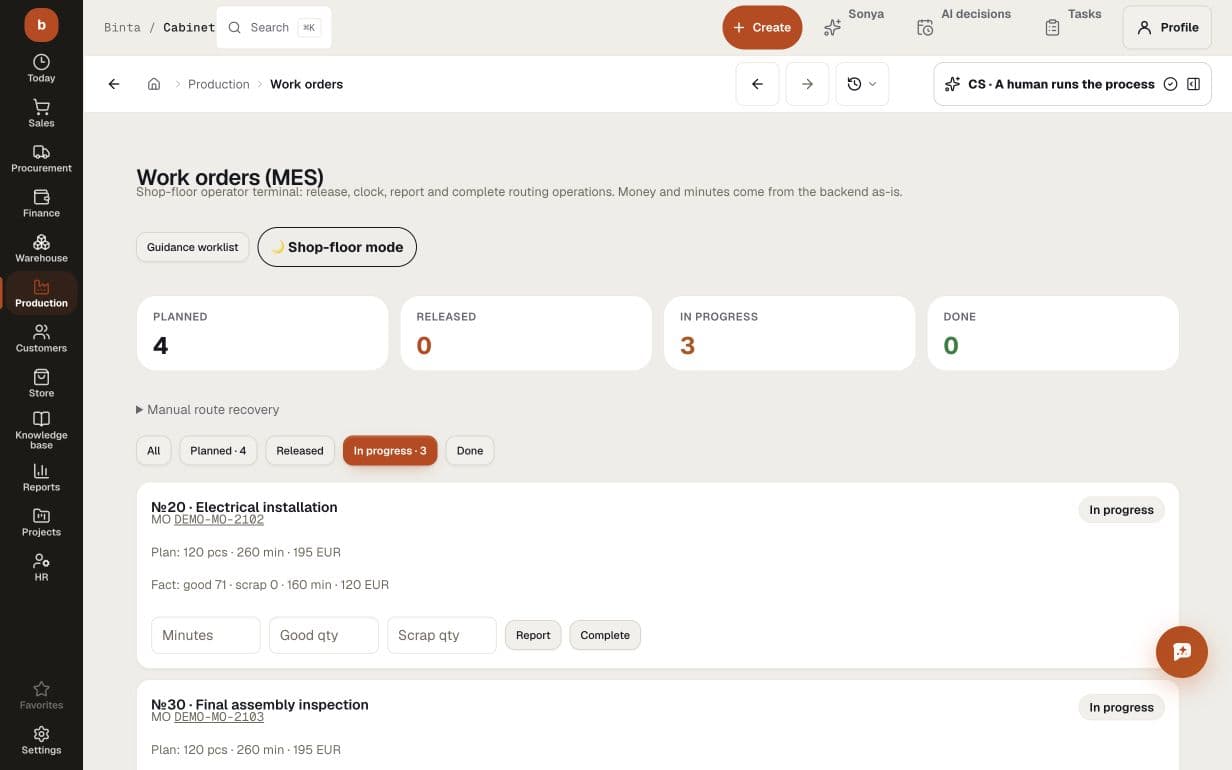
    The shop floor: work orders

    Work orders on work centres, operation-level execution, output and scrap. A Gantt chart shows what moves when one thing moves.

    PRODUCT ROUTE/production/work-orders
    01SignalThe shop floor: work orders
    02Digital employee preparesschedules orders across work centers by capacity and dates
    03Human decidesProposes the plan; the foreman confirms the release
    Work map built from the implemented product route — not a stock image.
  4. 04

    Cost: standard, actual, variance

    The bill sets the standard; alongside it live actual order cost, variances by price, usage, efficiency and overhead, costing cycles with freeze and postings, and work in progress by work centre. One connected loop, not scattered reports.

    PRODUCT ROUTE/production/variance
    01SignalCost: standard, actual, variance
    02Digital employee preparesschedules orders across work centers by capacity and dates
    03Human decidesProposes the plan; the foreman confirms the release
    Work map built from the implemented product route — not a stock image.
BUYER QUESTIONS

What teams usually need to know before they start

Can we start with Production without replacing everything at once?

Yes. Start with one workflow and the data it needs. Add adjacent modules only when the operating process calls for them.

What does AI do inside Production?

Digital employees watch product records, prepare the next action, surface exceptions and keep the decision trail. Their exact actions and authority gates are shown on this page.

Which decisions stay with people?

Your team sets the authority. External messages, money and irreversible actions stay approval-gated until you deliberately expand the operating mode.

How quickly can we see a working flow?

You can review the target flow with realistic demo data on day one and connect real evidence during the first week. For a typical company of up to 50 people, four weeks is the target for moving one operating loop; source quality, integrations and legal requirements can change it.

START WITH ONE REAL PROCESS

Bring the workflow that costs your team the most attention

Map its data, decisions and approval gates first. Then see exactly what the module and its digital employees can take over — before you commit to a wider rollout.

Other modules