Module

Procurement

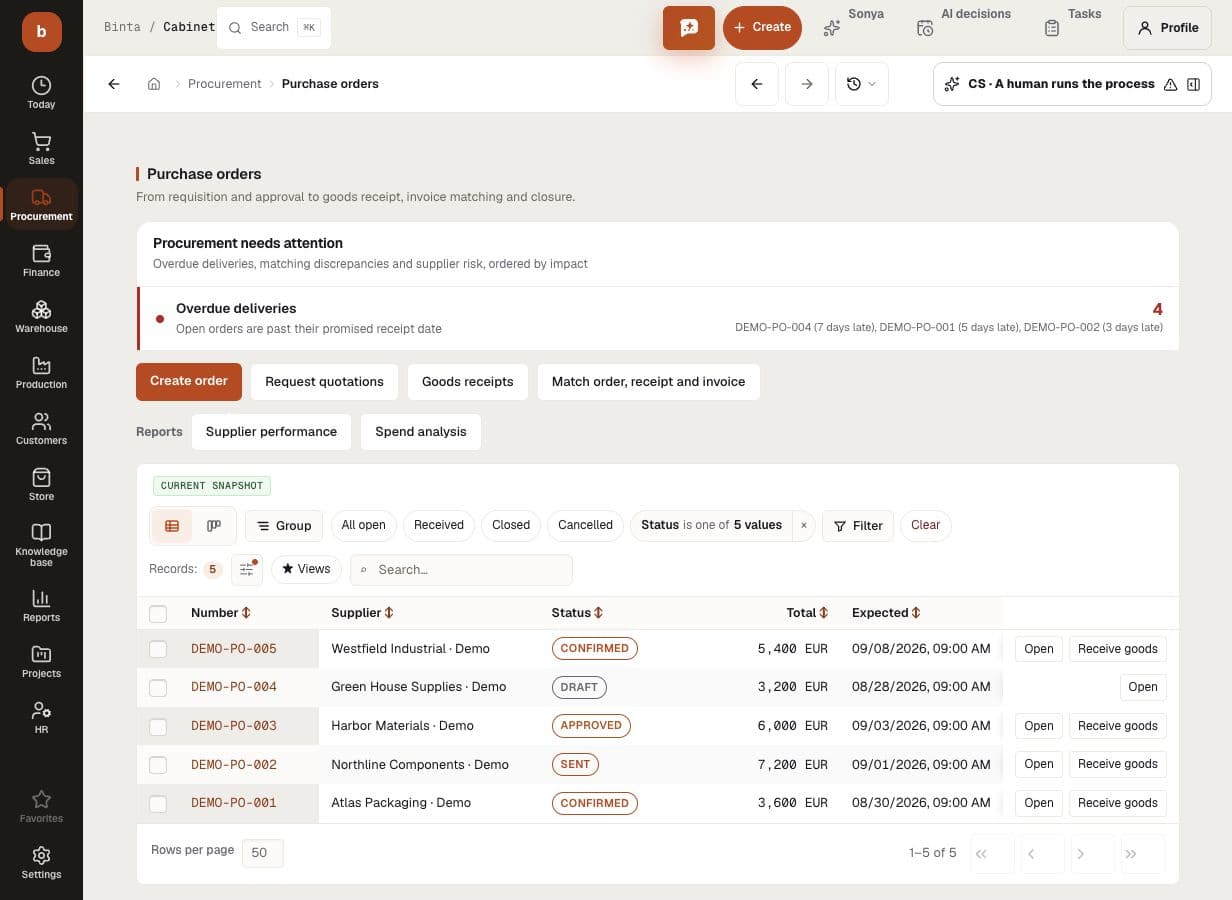
Procure-to-pay: RFQs, purchase orders, receiving, 3-way match

Purchasing that does the arithmetic for you: demand computed against supplier lead times, quotes requested from several suppliers and compared in one table, purchase orders and receipt with three-way matching — order, delivery note, invoice. A price or quantity mismatch surfaces before payment, not after. No purchase order leaves without a human approval. Anyone who buys needs it: without it stock lives in the buyer's memory.

Business outcome
Procure-to-pay: RFQs, purchase orders, receiving, 3-way match
Digital employee
Keeps stock healthy: computes demand and prepares the purchase
Human control
No purchase order leaves without a human approval
Verified product route
/procurement/rfq
Procurement
Demand
Short for a customer orderSource named
RFQ
Three suppliers repliedPrices compared
Purchase order
Order approvedBy the permission matrix
You see what caused the demandApproval is a single checkpoint
DIGITAL EMPLOYEES · LAUNCH

Digital employees run the work — AI is not a side panel

They read the same documents as your team, prepare the next action, surface exceptions and keep the decision trail inside the process.

You set the authority. External messages, money and irreversible actions remain approval-gated until verified evidence earns a wider mode.

  1. DAY 1See the process working

    Choose an industry preset and start with realistic demo data; the team sees the target flow before migration.

  2. FIRST WEEKConnect real evidence

    Import or connect source data. Digital employees observe, draft and expose gaps while people confirm decisions.

  3. TARGET · 4 WEEKSMove the operating loop

    For a typical 50-person company, the target is four weeks. Source quality, integrations and legal requirements can change it.

Who does the work

The digital employees of this module

A module is more than screens. Digital employees work behind them: they prepare the decision and bring it to you instead of waiting for you to type everything in. Below — who exactly, what they do, and where their authority stops.

Buyer

Keeps stock healthy: computes demand and prepares the purchase

  • computes what runs out and when, given supplier lead times
  • collects quotes from suppliers and compares the answers
  • drafts the purchase order — you approve it

No purchase order leaves without a human approval

WORK, NOT A FEATURE LIST

See what changes in the workflow — and where it lives in the product

Every capability below is tied to an implemented product route. A reviewed product screenshot is shown when it exists in this language; otherwise the route is explained as a transparent work loop, never as invented UI.

  1. 01

    From demand to purchase order

    Demands gather from orders, production and reorder points, turn into an RFQ and then into a purchase order. The chain is born linked — the order knows what caused it.

    PRODUCT ROUTE/procurement/demands
    01SignalFrom demand to purchase order
    02Digital employee preparescomputes what runs out and when, given supplier lead times
    03Human decidesNo purchase order leaves without a human approval
    Work map built from the implemented product route — not a stock image.
  2. 02

    Matching order, receipt and invoice

    Invoice, order and receipt reconcile automatically; price and quantity gaps surface before payment, not after the month is closed.

    PRODUCT ROUTE/procurement/three-way-match
    01SignalMatching order, receipt and invoice
    02Digital employee preparescomputes what runs out and when, given supplier lead times
    03Human decidesNo purchase order leaves without a human approval
    Work map built from the implemented product route — not a stock image.
  3. 03

    Contracts and approval rules

    Blanket contracts with prices and volumes, an approval matrix by amount and category. One gate, enforced on the server.

    PRODUCT ROUTE/procurement/approval-rules
    01SignalContracts and approval rules
    02Digital employee preparescomputes what runs out and when, given supplier lead times
    03Human decidesNo purchase order leaves without a human approval
    Work map built from the implemented product route — not a stock image.
  4. 04

    Which suppliers let you down

    Spend analysis by category and supplier discipline: lead times, short deliveries, price versus contract.

    PRODUCT ROUTE/procurement/reports/supplier-performance
    01SignalWhich suppliers let you down
    02Digital employee preparescomputes what runs out and when, given supplier lead times
    03Human decidesNo purchase order leaves without a human approval
    Work map built from the implemented product route — not a stock image.
BUYER QUESTIONS

What teams usually need to know before they start

Can we start with Procurement without replacing everything at once?

Yes. Start with one workflow and the data it needs. Add adjacent modules only when the operating process calls for them.

What does AI do inside Procurement?

Digital employees watch product records, prepare the next action, surface exceptions and keep the decision trail. Their exact actions and authority gates are shown on this page.

Which decisions stay with people?

Your team sets the authority. External messages, money and irreversible actions stay approval-gated until you deliberately expand the operating mode.

How quickly can we see a working flow?

You can review the target flow with realistic demo data on day one and connect real evidence during the first week. For a typical company of up to 50 people, four weeks is the target for moving one operating loop; source quality, integrations and legal requirements can change it.

START WITH ONE REAL PROCESS

Bring the workflow that costs your team the most attention

Map its data, decisions and approval gates first. Then see exactly what the module and its digital employees can take over — before you commit to a wider rollout.

Other modules